

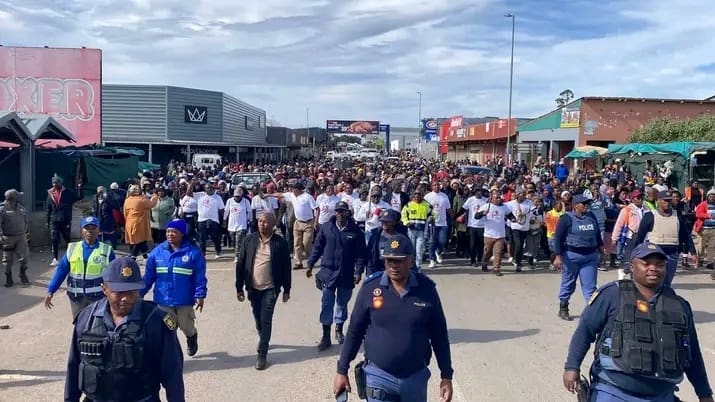
The reported plan to spend around R600 million on policing and security for a single planned march has sparked outrage and serious debate. Many South Africans are asking a simple question: how did it become this expensive just to manage one day of public expression?
No one is saying public safety should be ignored. A peaceful march must remain peaceful, and the state has every responsibility to prevent violence, protect infrastructure, and keep order. That is not in dispute. But the scale of the spending is what is shocking people.
R600 million is not a small operational cost. It is a massive deployment budget for a short-term event. And for many citizens, it raises a deeper concern about how the country is handling public tension.
Because if it takes that level of spending to manage one march, then the real issue is not the march itself. In many areas, there are ongoing signs of weakened control. Buildings are not always properly regulated. Some spaces fall into neglect and become linked to criminal activity. Over time, this creates environments where law enforcement struggles to maintain order consistently. Drug-related activity also continues to affect communities, contributing to crime and instability in everyday life. These are not sudden problems; they grow where enforcement is inconsistent and where systems are stretched or failing.
Yet when a march is announced, the response is immediate, highly visible, and extremely costly. That is where public frustration is growing. Why does it take hundreds of millions of rand to prepare for one day, but far less urgency to fix the conditions that create instability in the first place?
Police can control crowds. They can secure streets for a day. But they cannot fix long-term breakdowns in communities or rebuild systems that have been weakening for years. When those gaps are left unaddressed, they eventually show up again in the form of protests, anger, and disruption.
In my view, government has become too reactive focused on managing the moment instead of fixing the root causes that keep repeating the same cycle. Public safety is non-negotiable. But real safety is not measured only by how many officers are deployed during a march. It is measured by how well communities are governed every day, how quickly illegal activity is dealt with, and how consistently the law is enforced across all areas.
The uncomfortable question now is this: are we building stability, or simply paying more to temporarily contain instability? Because if R600 million is what it takes to manage one march, then the real crisis is not the march. It is everything that comes before it.