

Download the Pondoland Times app to get breaking national news, major government updates, public alerts, and important South African stories as they happen.
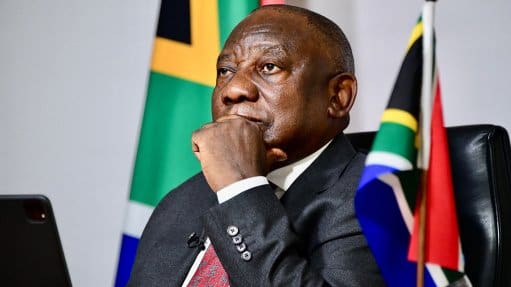
President Cyril Ramaphosa has firmly rejected calls for his resignation following the Constitutional Court’s judgment in the Phala Phala matter, announcing instead that he will seek an urgent judicial review of the independent panel report that triggered impeachment proceedings against him.
In a detailed national address, Ramaphosa defended his conduct, reaffirmed his commitment to the Constitution, and argued that stepping down now would undermine democratic processes and the work of rebuilding South Africa’s institutions.
The president’s remarks come after the Constitutional Court ruled that Parliament acted unlawfully when it voted in December 2022 not to proceed with an impeachment inquiry following the release of the Section 89 independent panel report into the Phala Phala scandal.
The panel had investigated allegations linked to the theft of foreign currency from Ramaphosa’s Phala Phala game farm in Limpopo in February 2020. The report concluded that information placed before the panel disclosed prima facie evidence that the president “may have committed serious misconduct and a serious violation of the Constitution.”
According to the panel, Ramaphosa may have acted inconsistently with his office and may have exposed himself to a conflict between his constitutional responsibilities and private business interests.
Despite those findings, the National Assembly voted against establishing an impeachment committee in December 2022.
The Constitutional Court has now overturned that parliamentary decision, ruling that the National Assembly failed to follow proper constitutional procedures. The court ordered that the panel’s report must now be referred to Parliament’s impeachment committee unless the report is first reviewed and set aside by a court.
Ramaphosa said the Constitutional Court judgment did not determine whether he was guilty of wrongdoing, but instead focused on procedural flaws in Parliament’s handling of the matter.
“The Constitutional Court made no finding of any kind regarding my alleged conduct,” Ramaphosa said.
“The Court made no finding on whether there was prima facie evidence of misconduct nor if the alleged conduct, if established, justifies impeachment and the removal of the President.”
The president said he had long believed the independent panel report contained serious legal and factual flaws. He revealed that after the report was released in 2022, his legal advisors recommended that he challenge it in court on several grounds, including what they described as a misunderstanding of the panel’s mandate, major legal errors, and unsupported factual conclusions.
However, Ramaphosa said he initially chose not to proceed with a judicial review because Parliament’s decision against impeachment effectively rendered the report without legal consequence at the time.
That changed after the Constitutional Court ruling restored legal force to the panel’s recommendations.
“As the court ruled, the independent panel’s recommendation to proceed with an impeachment inquiry must be implemented unless and until the report is set aside on review,” Ramaphosa said.
“I have therefore decided to proceed to take the independent panel’s report on review on an expeditious basis.”
Ramaphosa insisted that taking the matter on review was not an attempt to undermine Parliament or evade accountability, but rather an effort to ensure that any impeachment proceedings are based on legally sound findings.
“I do so not out of disrespect for Parliament or its processes, but to affirm the need for such findings to be correct in law and in fact,” he said.
The president also addressed growing political pressure from opposition parties and critics who have demanded that he resign.
“I therefore respectfully want to make it clear that I will not resign,” Ramaphosa declared.
“To do so would be to pre-empt a process defined by the Constitution.”
He argued that resigning before the legal process unfolds would effectively endorse what he believes to be a flawed report and abandon the responsibilities entrusted to him as president.
“To resign now would be to give in to those who seek to reverse the renewal of our society, the rebuilding of our institutions, and the prosecution of corruption,” he added.
Ramaphosa used the address to position the controversy within the broader context of South Africa’s constitutional democracy, stressing the importance of judicial independence, due process, and institutional stability.
He said the Constitution provides a carefully designed framework for dealing with allegations against a sitting president while also protecting against politically motivated or malicious claims.
“At times of such uncertainty and contestation, our Constitution must and remains our guide,” Ramaphosa said.
The president further defended his administration’s record since taking office, arguing that significant progress has been made in restoring state institutions weakened during the era of state capture.
He pointed to efforts to recover stolen public funds, prosecute corruption-related crimes, intensify action against organised crime and gang violence, and implement recommendations from the Judicial Commission of Inquiry into Allegations of State Capture.
Ramaphosa also referenced ongoing investigations into corruption and criminality within law enforcement agencies through the Mufamadi Commission process.
The Phala Phala scandal has remained one of the most politically damaging controversies of Ramaphosa’s presidency since allegations first surfaced publicly in 2022 after former State Security Agency director-general Arthur Fraser laid criminal charges against the president.
Questions around the source of the foreign currency, how the robbery was handled, and whether proper reporting procedures were followed after the theft have continued to dominate national political debate.
With the Constitutional Court now directing Parliament to revive the impeachment process, the matter is expected to return to the centre of South Africa’s political landscape in the coming months.
At the same time, Ramaphosa’s planned court review could trigger another major legal battle over the validity of the independent panel’s findings and the future of the impeachment process itself.