

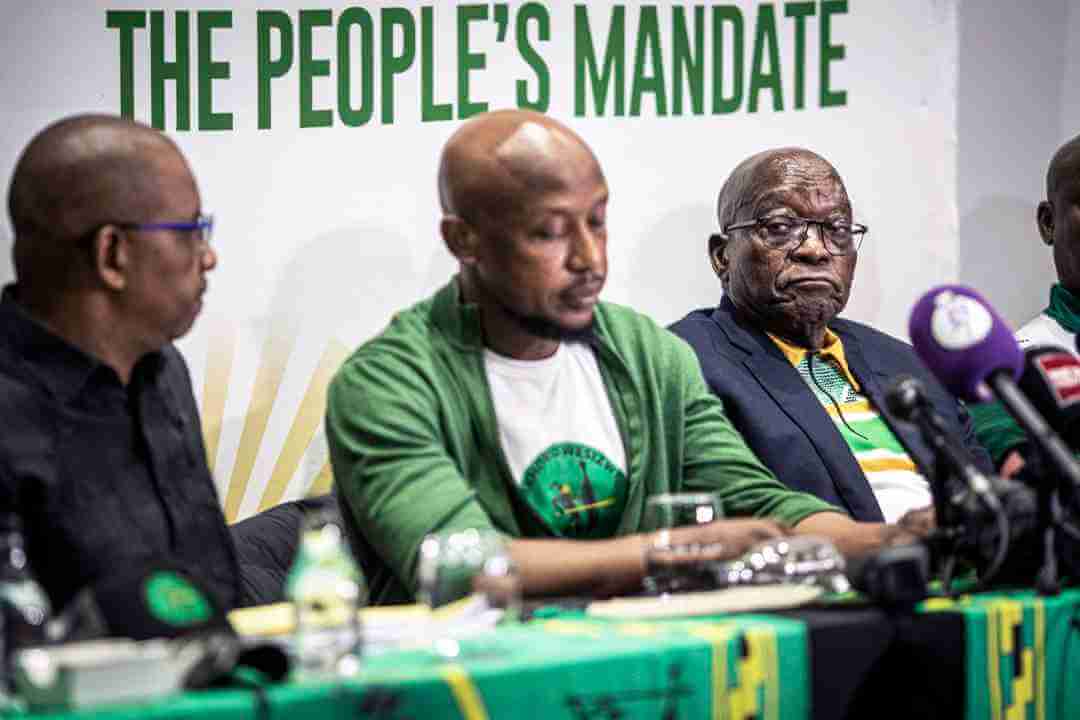
The uMkhonto weSizwe Party (MKP), led by former president Jacob Zuma, has denounced the Constitutional Court’s ruling as a “travesty of justice” after the apex court declined to hear its urgent application against President Cyril Ramaphosa’s handling of Police Minister Senzo Mchunu.
At issue is the president’s decision to place Mchunu on special leave and appoint constitutional law professor and former MP Firoz Cachalia as Acting Minister of Police. MKP contends the president acted beyond his constitutional authority, sidestepping Parliament and undermining democratic oversight.
In a decision delivered by Chief Justice Rammaka Mathopo, the court ruled that the matter did not meet the threshold for direct access and must first be heard in the High Court. The judgment stressed that disputed facts—such as those surrounding the president’s motives and executive discretion—are better resolved in a lower court.
MKP rejected the ruling outright, accusing the judiciary of shielding Ramaphosa and applying double standards. “The same court once allowed direct access for matters involving Jacob Zuma,” said MKP spokesperson Nhlamulo Ndhlela. “Now, it turns its back on us. Lady Justice is no longer blind—she has chosen a side.”
The dispute stems from a dramatic public statement by KwaZulu-Natal Police Commissioner Nhlanhla Mkhwanazi, who alleged that Mchunu interfered in multiple high-stakes investigations and had links to criminal syndicates. In response, Ramaphosa established a judicial commission of inquiry—chaired by retired Deputy Chief Justice Mbuyiseli Madlanga—tasked with investigating corruption within law enforcement ranks.
Legal analysts say the case highlights a critical debate over executive power and the potential abuse of presidential discretion to neutralise political threats. MKP argues that using special leave and judicial inquiries without court charges or parliamentary process risks setting a dangerous precedent for governance.
The party has vowed to escalate its campaign through both legal and political means. It is preparing a High Court application and exploring further constitutional remedies. Additionally, MKP plans to mobilise nationwide protests and introduce a motion of no confidence in Parliament.
“This isn’t just about Minister Mchunu—it’s about the creeping erosion of constitutional democracy,” said MKP national organiser Thandeka Zungu. “We are witnessing centralised power being used to silence dissent.”
Civil society groups have expressed mixed reactions, with some welcoming the inquiry as a means of promoting accountability, while others worry about the politicisation of judicial mechanisms.
With Cachalia’s appointment confirmed and the Madlanga Commission expected to begin hearings later this month, the issue is far from over. Analysts note that the fallout could influence public trust in both the judiciary and the executive ahead of the 2026 municipal elections.
The African National Congress (ANC) has yet to issue a formal statement on the court’s decision. Meanwhile, opposition parties and watchdog organisations are watching closely as the battle over the country’s legal and political balance of power intensifies.