

Unlock this story — it’s free
Download the Pondoland Times app to get breaking national news, major government updates, public alerts, and important South African stories as they happen.
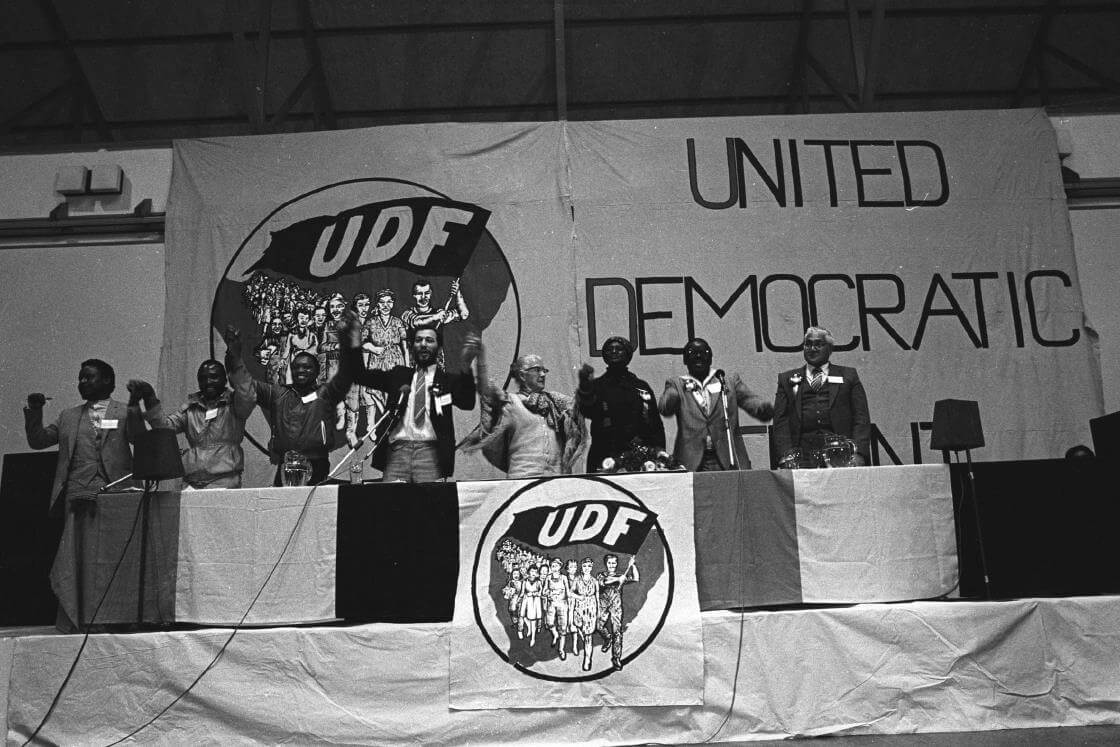
The United Democratic Front became one of the largest anti-apartheid movements in South Africa during the 1980s.
The United Democratic Front (UDF) was launched in 1983 to unite community groups, unions, churches and civic organisations opposed to apartheid.
The movement helped coordinate nationwide resistance campaigns and supported the struggle for democratic rule in South Africa. According to the South African History Archive, the organisation brought together more than 400 groups under one national umbrella.
What happened
The UDF was formed in August 1983 in Cape Town during a meeting of community organisations and activists.
Its creation was a response to the apartheid government’s plan to introduce the Tricameral Parliament, which excluded Black South Africans from national political power.
The new political system allowed limited representation for Indian and Coloured communities but maintained white minority control.
Many organisations rejected the proposal. As a result, the UDF was formed to coordinate resistance and promote the demand for a democratic political system based on one person, one vote.
Key details about the UDF
| Detail | Information |
|---|---|
| Organisation | United Democratic Front |
| Founded | August 1983 |
| Location of launch | Cape Town |
| Type | Anti-apartheid coalition movement |
| Member organisations | More than 400 groups |
| Main goal | Oppose apartheid and promote democratic governance |
The UDF brought together a wide range of groups including civic organisations, church bodies, youth movements and trade unions.
Although it was not a political party, it worked closely with the banned African National Congress (ANC) and supported its goals during the apartheid era.
Why it mattered
The UDF played a major role in organising mass resistance to apartheid inside South Africa.
Throughout the 1980s, the movement coordinated:
- Nationwide protests and rallies
- Community campaigns against apartheid policies
- Consumer boycotts
- Student and youth mobilisation
- Local civic resistance to apartheid authorities
Through these campaigns, the organisation helped mobilise millions of South Africans against apartheid rule.
The apartheid government viewed the movement as a major threat and responded with arrests, detentions and states of emergency.
What happened next
The UDF remained active throughout the 1980s as one of the largest internal resistance movements.
However, the organisation began to wind down after liberation movements were unbanned in 1990 and negotiations to end apartheid started.
In 1991, the UDF formally disbanded as many of its activists joined political parties and democratic institutions in the new South Africa.
Today, historians recognise the UDF as one of the most important grassroots movements in the country’s struggle for freedom.
Where to learn more
Readers can access additional historical information through:
- South African History Online
- South African National Archives
- University history departments and libraries
These sources provide documentation on the role of civic organisations in the anti-apartheid movement.